Why soil matters more than concrete
Most foundation problems around Wichita aren't caused by bad concrete. They come from the ground under and around it. A foundation is only as stable as the soil holding it up, and soil changes with the weather. When some of it gets wetter, drier, softer or denser than the rest, the house above can move unevenly. That's when you see cracked drywall, sticking doors and stair-step cracks in brick or block. This guide explains what's going on in the ground around Wichita and how to check your own property, using public sources from the USDA Natural Resources Conservation Service (NRCS), the Kansas Geological Survey (KGS) and K-State Research and Extension.
What "expansive clay" means
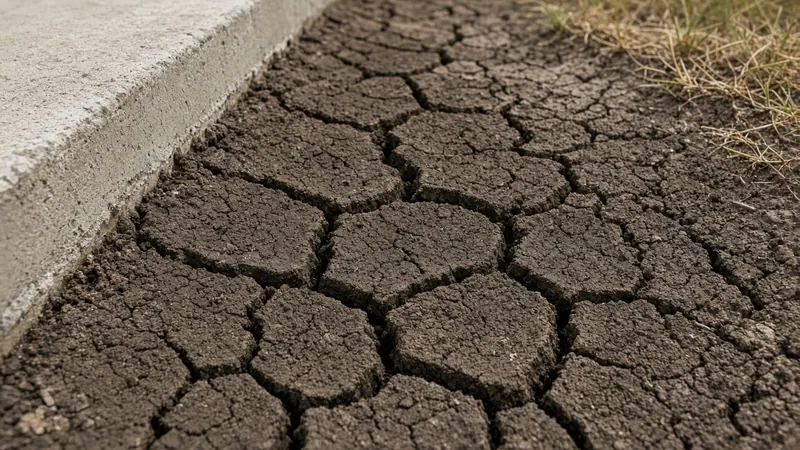
Clay is made of extremely small, flat mineral particles. Some clay minerals, especially the smectite group, take water into their structure and swell when wet, then shrink as they dry. A soil rich in those minerals can push hard enough on a foundation wall or slab to lift it. Then, in a drought, it can shrink away and leave part of the foundation with less support. K-State Research and Extension notes that this shrink-swell pressure can crack foundations and basement walls and shift sidewalks.
NRCS measures this tendency as linear extensibility (LEP): the percent change in a soil's length between moist and oven-dry. Its Soil Survey Manual groups the results into classes:
| Shrink-swell class | Linear extensibility |
|---|---|
| Low | less than 3% |
| Moderate | 3% to less than 6% |
| High | 6% to less than 9% |
| Very high | 9% or more |
NRCS notes that once linear extensibility goes above about 3%, shrinking and swelling can damage buildings, roads and other structures. In other words, a "moderate" rating is already enough to matter for a foundation.
The geology under Wichita
The Kansas Geological Survey's report on Sedgwick County geohydrology gives the big picture. Most of the county, roughly the eastern two-thirds, is underlain by the Wellington Formation, a Permian-age gray shale with beds of gypsum and anhydrite. The Ninnescah Shale underlies the western part. In places, groundwater has dissolved gypsum in the Wellington and the overlying rock has locally sagged or deformed. KGS says this is best seen in Kansas Turnpike road cuts northeast of Wichita.
Above the bedrock, the Arkansas River valley is filled with river deposits: sand and gravel that grade upward into clayey silt. KGS describes these valley deposits as averaging about 45 feet thick and up to about 9 miles wide. In much of that area, the water table is less than 10 feet below the surface. Older terrace deposits of sand and gravel also extend across parts of the county, including a terrace up to about 7 miles wide southwest of Maize. Wind-blown silt (loess) blankets many of the uplands and is thickest on the slopes bordering the valley.
Soils have formed on top of all of this, and they differ a lot from place to place. Sandy, low-swell soils are common on the river deposits. Clay-rich, high-swell soils are common on the uplands formed from loess and weathered shale.
What the soil survey shows around the metro
To see how much this varies, we queried the NRCS soil survey database (Soil Data Access) at nine sample points around the Census Bureau's center point for Wichita and for each of six nearby cities. The table shows the main map units we found and the highest shrink-swell rating in each one's typical profile. It is a sample, not a survey of every lot.
| Area | Main map units in our sample | Shrink-swell (max) |
|---|---|---|
| Central Wichita | Urban land–Canadian complex; Urban land–Elandco complex | Low |
| Haysville | Canadian fine sandy loams; Blanket silt loam; Saltcreek | Low to high |
| Maize | Solvay loamy fine sand; Nalim loam; Punkin–Taver complex | Low to very high |
| Derby | Vanoss silt loam; Irwin silty clay loam | Moderate to high |
| Park City | Farnum loam; Tabler silty clay loam; Milan loam | Moderate to high |
| Andover | Irwin silty clay loam; Rosehill silty clay | High to very high |
| Bel Aire | Rosehill silty clay; Goessel silty clay | Very high |
"Urban land" means NRCS mapped the area as mostly covered or disturbed by buildings and pavement. Fill and grading there may differ from the natural soil. Goessel silty clay is a Vertisol, the soil order defined by shrink-swell clays that crack deeply when dry. The takeaway is that the Wichita area isn't one soil. A house in the river valley and a house on the northeast uplands can face very different conditions.
How soil movement shows up in a house
On expansive clay, movement usually follows the seasons. In a hot, dry summer, the soil shrinks, gaps open between the soil and the foundation, and cracks may widen. Fall rains or heavy watering swell the soil back, and some cracks partly close. Over years, uneven wetting and drying can leave one part of the house higher or lower than another. Common signs include:
- stair-step cracks in brick or block, or diagonal cracks from the corners of doors and windows
- doors and windows that stick or won't latch, especially when the weather changes
- horizontal cracks or inward bowing in basement walls
- gaps between the floor and baseboards, or floors that feel out of level
- sidewalk, patio or driveway slabs that have tilted or dropped
Sandy soils don't swell much. In those areas, problems more often trace to water: a high water table, a leaking line, or roof water that softens the soil under one corner. Either way, the pattern of cracks and when they change helps an inspector tell which is which.
What homeowners can do
K-State Research and Extension's guidance is mostly about keeping soil moisture steady and moving water away from the house:
- Slope the ground away. K-State's Dry Basements and Crawl Spaces (MF2809) recommends a slope away from the foundation of at least 6 inches in 10 feet. About one inch per foot for the first 15 feet is ideal. Backfill next to a foundation often settles and can reverse the slope, so recheck it during routine yard work.
- Control roof water. Keep gutters clean, and use downspout extensions or pipes to carry water away rather than letting it pool beside the wall.
- Water during drought. K-State Extension suggests watering the soil within a foot or two of the house during long dry spells, so the clay doesn't shrink away from the foundation.
- Don't pack dry cracks with soil. K-State warns that if you fill and tightly compact cracks next to a basement wall when the soil is dry, the soil can expand when it rewets. The added pressure can crack a wall or even cause it to collapse.
- Watch window wells. Make sure they drain and that roof runoff doesn't flow into them.
When it's time for a professional
Drainage fixes help prevent damage, but they won't straighten a wall that has already bowed or lift a settled footing. If cracks keep widening or show one side offset from the other, or if a basement wall is bowing, have it inspected. Depending on the cause, a contractor might recommend steel piers to stabilize footings, wall anchors or braces for basement walls, crawl space supports, or slab leveling. For major work, a structural engineer's evaluation is worth considering. If you're wondering who pays, see does homeowners insurance cover foundation repair?
Look up your own lot
You can check the soil under your own home for free. Open the NRCS Web Soil Survey and choose "Address" under Area of Interest. Draw a box around your lot, then open the Soil Map tab to see the map unit name. On the Soil Data Explorer tab, under Soil Properties and Qualities, the Soil Physical Properties group includes Linear Extensibility, which you can compare with the classes above.
Sources
- USDA-NRCS Soil Survey Manual, Chapter 8 (linear extensibility and shrink-swell classes)
- USDA-NRCS Soil Data Access and Web Soil Survey (map units and properties; queried Oct 2026)
- Kansas Geological Survey, Geohydrology of Sedgwick County: geology and geologic formations
- K-State Research and Extension MF2809, Dry Basements and Crawl Spaces (2008)
- K-State Research and Extension, Johnson County, "Clay Soil: It shrinks and swells" (horticulture column)